

In recent years, while many issues have been raised related to food safety and the environment, the safety of textiles, which are indispensable for everyday life, has become a particular concern. Countries throughout the world, and especially in the EU, are regulating and investigating hazardous chemicals in textiles. Additionally, regulations have been tightened with respect to hazardous chemicals in textiles. This includes the adoption of the OEKO-TEX® Standard 100, a globally consolidated, independent examination and authentication system for textiles, and the implementation of voluntary regulations by various manufacturers. In addition to the currently regulated components, this method package provides analysis methods covering the major compounds in the OEKO-TEX® Standard 100 and voluntary regulations by various manufacturers.
This contains MRM information on 24 compounds, consisting of 2,4-xylidine and 2,6-xylidine in addition to 22 compounds targeted by regulations in the EU. It covers compounds targeted by regulations in a variety of countries including China and Japan.
This targets PFOS and PFOA, which are included in the regulations, as well as their related salts, and even perfluoro compounds that are not included in the regulations at present.
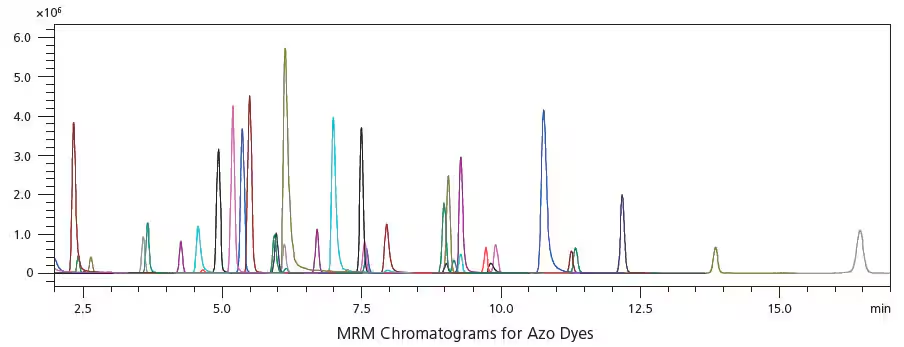
This targets compounds that are listed in the OEKO-TEX® Standard 100 and other regulations as carcinogenic dyes and allergic dyes. Additionally, it covers 27 compounds noted in EU Directive 2009/567/EC.
This covers 2 compounds-nonylphenol ethoxylate and octylphenol ethoxylate, listed in ISO18254, and the 4 main alkylphenols.
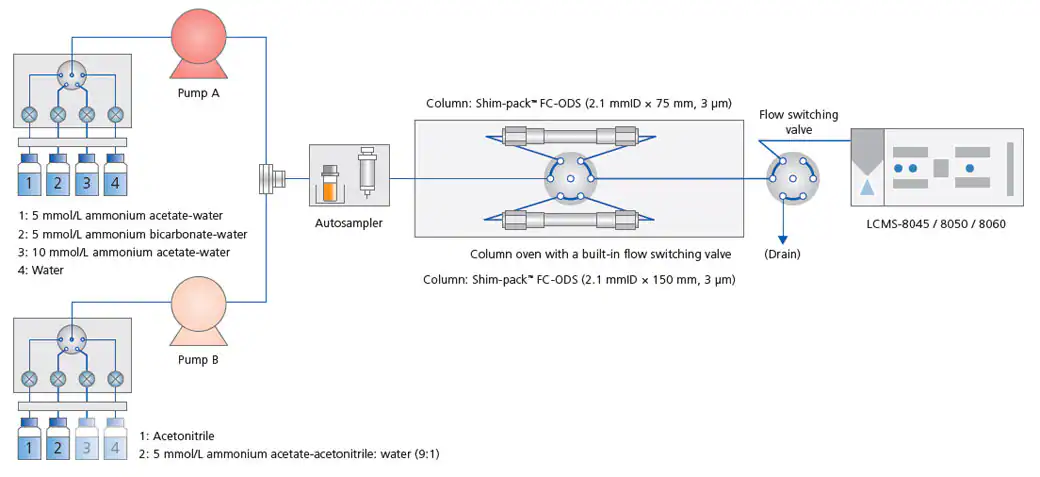
This method package contains 6 methods. A shared column is used for the 5 analyses, excluding the certain aromatic amines. Additionally, the mobile phases are shared as much as possible, with 4 aqueous solvents and 2 organic solvents. As shown in the figure below, introducing a column switching system enables the analysis of all the components targeted by this product, just by changing the combination of the mobile phase and column.
| Method 1 | Method 2 | Method 3 | Method 4 | Method 5 | Method 6 | |
|---|---|---|---|---|---|---|
| Target Compounds | 24 certain aromatic amines | 44 azo dyes | 7 azo dyes | 24 perfluoro compounds | 2 APEOs | 4 APs |
| Column | Shim-pack FC-ODS (2.1 mmID x 150 mm, 3 µm) | Shim-pack FC-ODS (2.1 mmID x 75 mm, 3 µm) | Shim-pack FC-ODS (2.1 mmID x 75 mm, 3 µm) | Shim-pack FC-ODS (2.1 mmID x 75 mm, 3 µm) | Shim-pack FC-ODS (2.1 mmID x 75 mm, 3 µm) | Shim-pack FC-ODS (2.1 mmID x 75 mm, 3 µm) |
| Mobile Phase A | 5 mmol/L ammonium acetate-water | 5 mmol/L ammonium acetate-water | 5 mmol/L ammonium bicarbonate-water | 5 mmol/L ammonium acetate-water | 10 mmol/L ammonium acetate-water | Water |
| Mobile Phase B | Acetonitrile | 5 mmol/L ammonium acetate-acetonitrile: ( 9 : 1) | Acetonitrile | Acetonitrile | Acetonitrile | Acetonitrile |
| Run Time | 13 min | 20 min | 10 min | 13 min | 7 min | 11 min |