

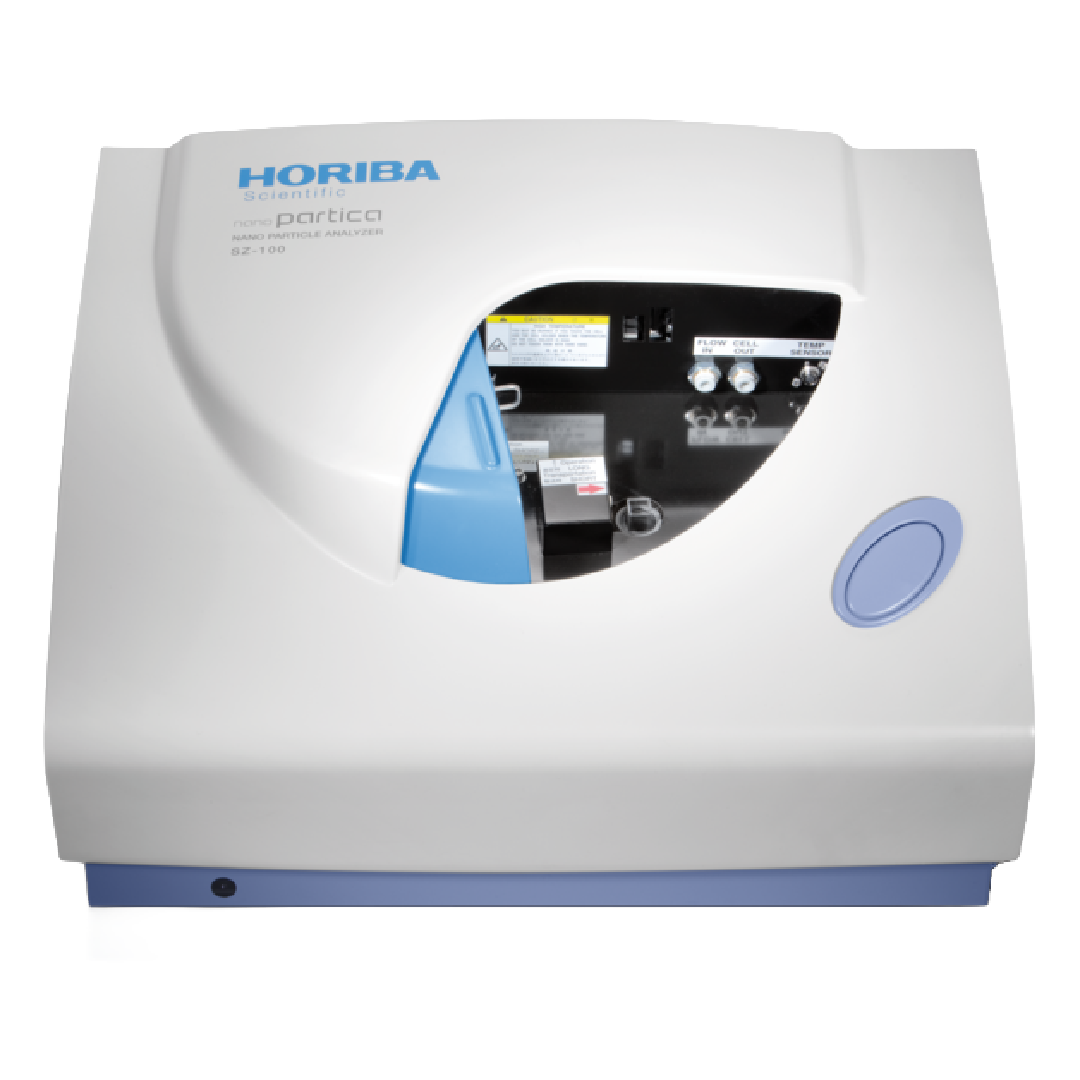
Nanotechnology research and development is a continuously evolving effort to control substances at the atomic and molecular level in order to achieve new and better materials and products. The miniaturization of components – that is, control at the nano-level – is necessary to achieve faster, higher-performance devices and functions and to reduce energy consumption. Nanotechnology has come to play a key role in wide-ranging fields that affect our daily lives, including food, cosmetics, and the life sciences.
Analysis across a wide range of sample concentrations: Measurement of samples ranging from low ppm-order concentrations to high-concentration samples in double-digit percentages is possible. Accepts commercially available sampling cells. Analysis of small-volume samples is also possible.
Analysis of sample volumes as small as 100 μL using HORIBA-developed microelectrophoresis cells. Use the value of zeta potential to predict and control dispersion stability. High zeta potential magnitudes indicate a stable dispersion, useful for formulation work.
Absolute molecular weight (Mw) and the second virial coefficient (A2) are obtained by performing static light scattering measurement as a function of sample concentration and preparing Debye plots.
| Model | SZ-100-S2 and SZ-100-HS2 (particle size and molecular weight measurement only) |
|---|---|
| Measurement principles |
Particle size measurement: Dynamic Light Scattering Molecular weight measurement: Debye plot method (static scattered light intensity) |
| Measurement range |
Particle size: 0.3 nm to 10 μm Molecular weight: 1000 to 2 × 10⁷ Da (Debye plot) 540 to 2 × 10⁷ Da (MHS Equation)*1 |
| Maximum sample concentration | 40 wt%*2 |
| Particle size measurement accuracy | Measurement accuracy of ±2% for NIST traceable polystyrene latex 100 nm spheres (not including variation in the standard particles themselves) |
| Measurement angles | 90° and 173° (automatic or manual selection) |
| Cells | Cuvettes |
| Measurement time |
Approx. 2 min. under ordinary conditions (from the start of measurement to the display of results for particle size measurement) |
| Required sample volume | Minimum volume of 12 μL*3 to 1000 μL (differs depending on cell material) |
| Usable liquids | Water, ethanol, organic solvents |