

The slits themselves are bilaterally, continuously adjustable from the computer in units of bandpass or millimeters. This preserves maximum resolution and instant reproducibility.
The excitation monochromator is an aspheric design which ensures that the image of the light diffracted by the grating fits through the slit. The gratings themselves are plane, blazed gratings that avoid the two major disadvantages of the more common concave holographic gratings: poor polarization performance and inadequate imaging during scans that throws away light. The unique wavelength drive scans the grating at speeds as high as 80 nm/s. The grating grooves are blazed to provide maximum light in the UV and visible region.
Before the excitation light reaches the sample, a photodiode reference detector monitors the intensity as a function of time and wavelength. The photodiode detector has a wider wavelength response than the older, traditional rhodamine-B quantum counter, and requires no maintenance.
A spacious sample chamber is provided to allow the use of a long list of accessories for special samples, and encourages the user to utilize a variety of sample schemes.
All the outstanding features of the excitation monochromator are also incorporated into the emission monochromator. Gratings are blazed to provide maximum throughput in the visible region.
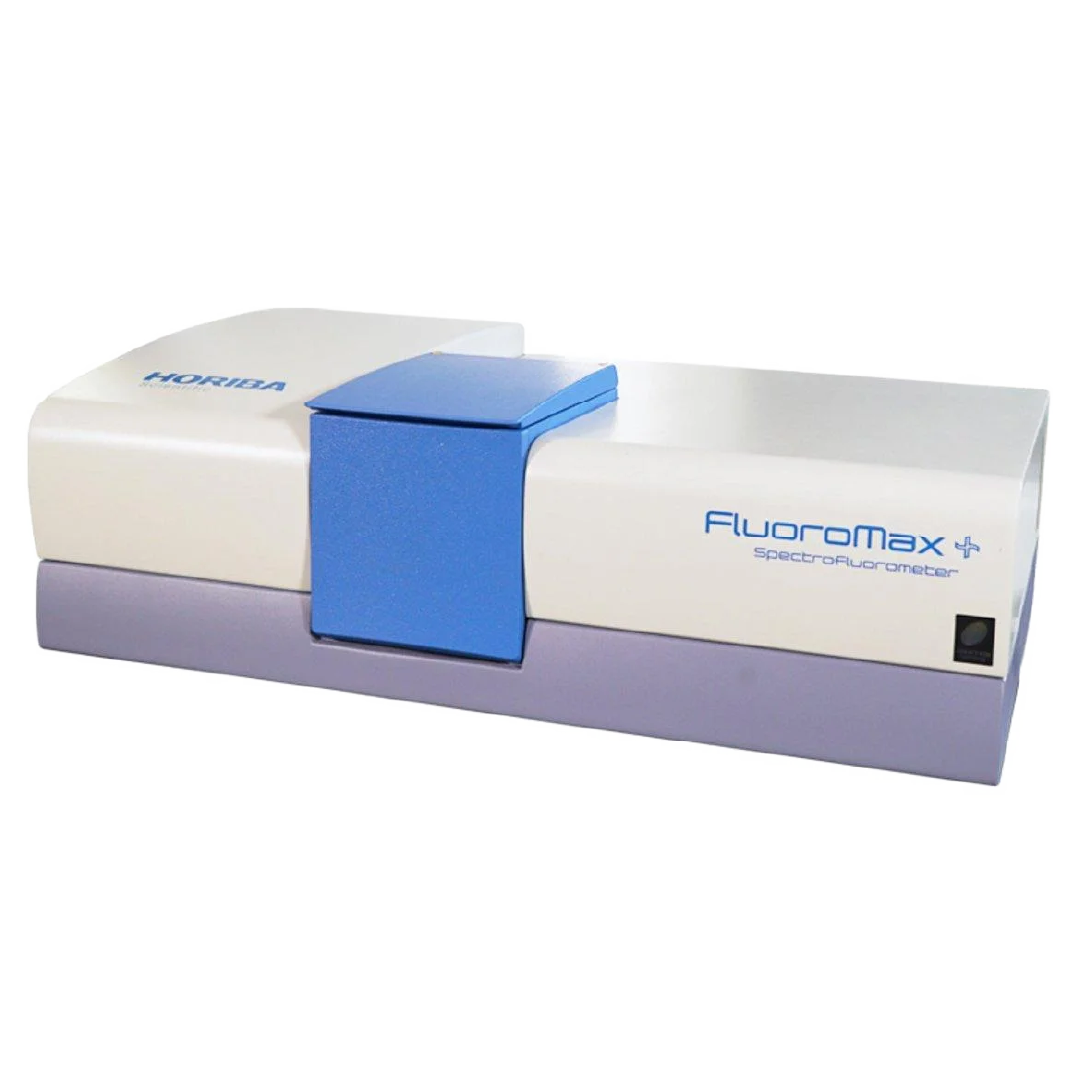
The entire control of the FluoroMax originates in your PC with our FluorEssence™ software and is transmitted through a USB link. On start-up, the system automatically calibrates and presents itself for new experiments, or stored routines instantly called from memory.
A wide variety of accessories are applications-oriented and most are interchangeable with the FluoroMax system.
| Lamp | Vertically mounted, CW, 150 W Ozone-free xenon arc lamp |
| Gratings | 1200 groove/mm blazed at 330 nm (excitation) and 500 nm (emission), plane ruled |
| Automatic self-calibration of all wavelength drives and slits | |
| Monochromators | All reflective optics, Czerny-Turner spectrometers |
| Detectors | Emission: R928P photon counting PMT (185–850 nm) and reference photodiode for monitoring lamp output |
| Water Raman S/N | 10,000:1 (FSD method). See Signal-to-noise ratio |
| Slits | Continuously variable from 0 to 29 nm |
| Accuracy | 0.5 nm |
| Repeatability | 0.1 nm |
| Minimum step | 0.0525 nm |
| Integration time | 0.001 to 160 sec |
| Software | FluorEssence |
| Spectral Correction Factors | Included |