
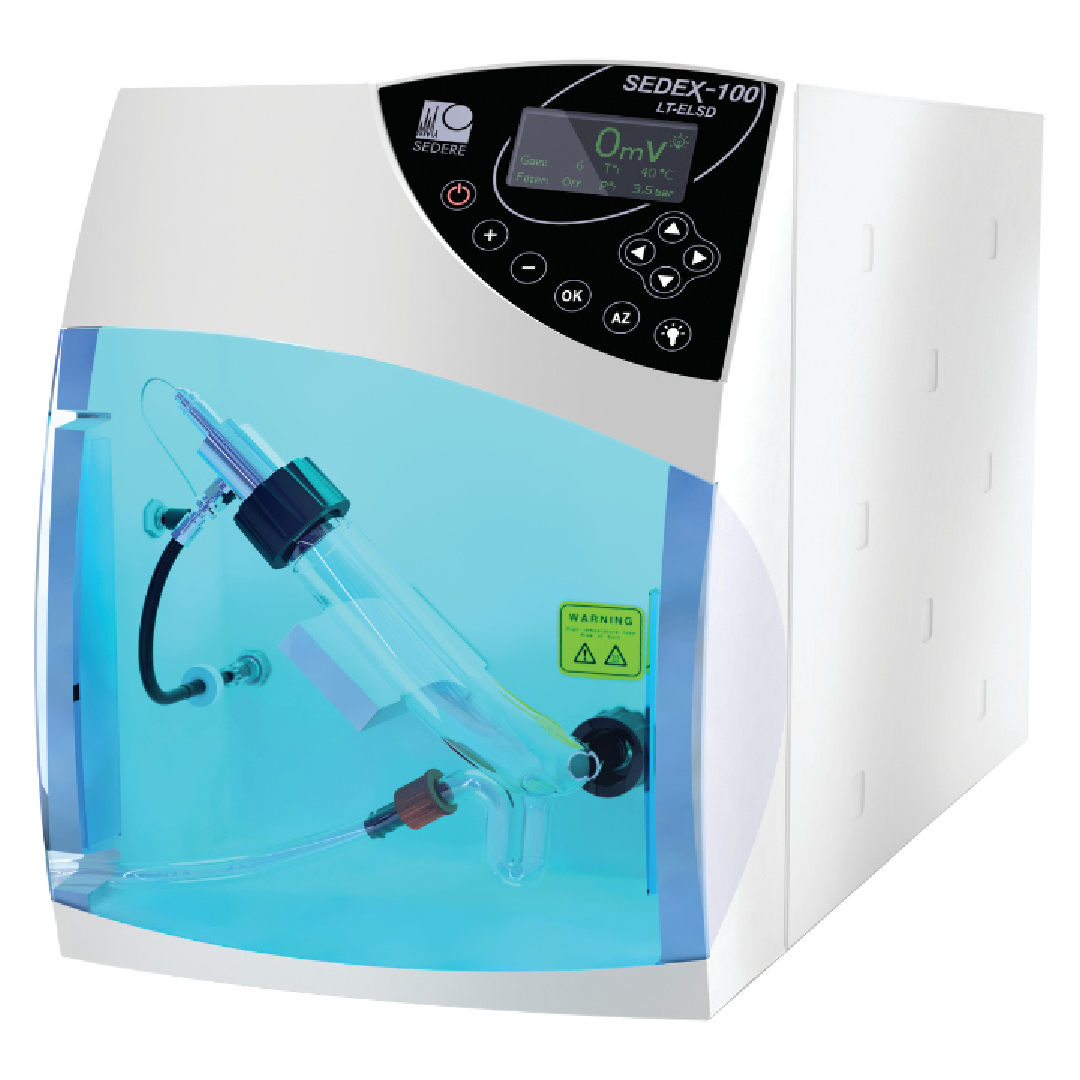
The SEDEX 100LT represents the highest tier of Low‑Temperature Evaporative Light‑Scattering Detection (LT‑ELSD), delivering unmatched sensitivity, robustness, and truly universal detection for HPLC, UHPLC and SFC applications. It reveals analytes that UV, RI, or MS cannot detect without complex conditions, ionization steps, or chromophore requirements – making it a premier choice for high‑precision quantification and comprehensive sample profiling.
Built on SEDERE’s exclusive Low‑Temperature evaporation technology, the SEDEX 100LT detects virtually all compounds less volatile than the mobile phase, regardless of optical or electrochemical properties. Its advanced optical and electronic design ensures maximum performance while maintaining an attractive price‑to‑performance ratio.
The SEDEX 100LT integrates a suite of high‑precision components to deliver best‑in‑class analytical performance:
Thanks to its optimized nebulization system and highly refined optical scattering detection, the SEDEX 100LT achieves sensitivity levels comparable – and in many applications superior – to Charged Aerosol Detectors (CAD).
As against an ion-transfer charging process before signal is measured in the case of CAD, LT-ELSD uses direct optical detection measuring light scattered particles immediately after nebulization and drying without any ion-transfer steps. This process is more universal in its response across diverse analyte classes.