Brochure
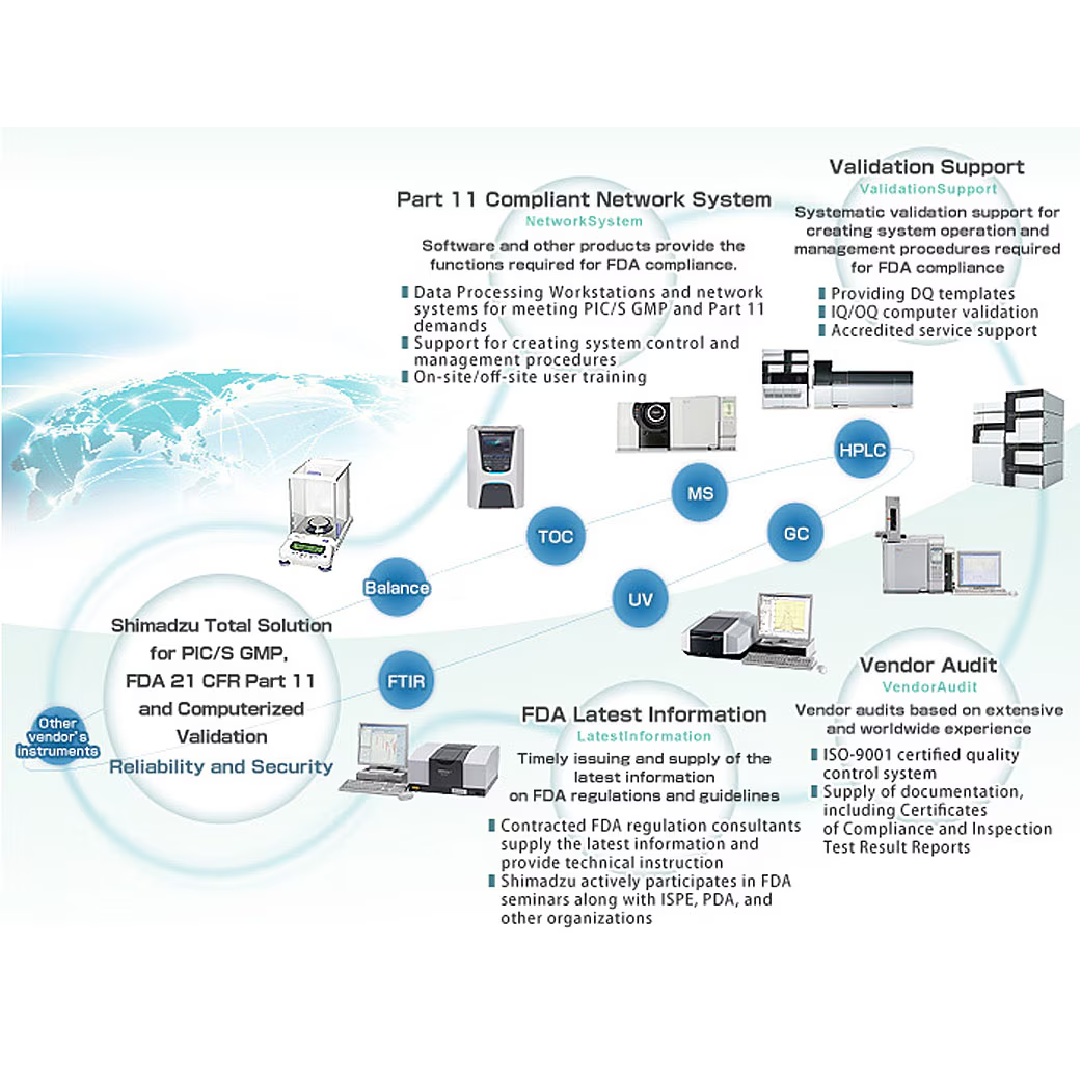
All Shimadzu network system products incorporate functions for the PIC/S GMP and the Part 11 compliance regulation, and computerized system validation functions required by GxP. Shimadzu provides documentation including IQ/OQ, Certificates of Compliance, and Inspection Test Result Reports based on Shimadzu IS09001 certified system. Shimadzu’s accredited service personnel offer full support for validation of customer’s Shimadzu products. In the latest information on PIC/S and FDA regulations through seminars and workshops, participating in vendor audits demanded by agencies, and actively assisting customers to comply with new regulations.
Shimadzu HPLC, GC, Mass Spectrometers, UV-VIS spectrophotometers and other spectroscopy products and their associated data processing systems all incorporate sophisticated, leading-edge technology for Access control, Audit trail, and Protection and Security of data functions to comply with regulatory demands. In addition to offering instrumentation and network-compatible software, Shimadzu offers total support for creating system control and management procedures, provides information, organizes seminars, and offers post-installation training on PIC/S GMP and Part 11.
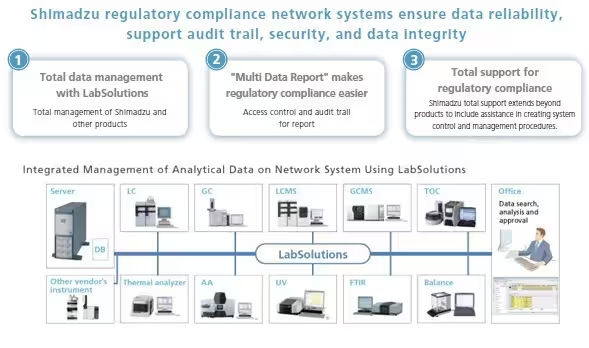
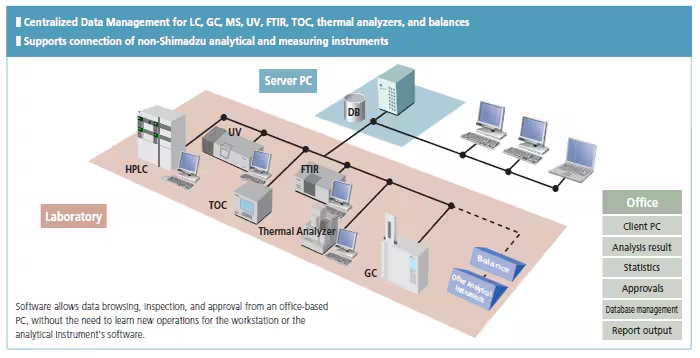
Shimadzu’s basic policy is to comply with regulations by integrating data management for all instruments used in the laboratory, including chromatographs and mass spectrometers (HPLC, GC, LC-MS, GC-MS), spectrophotometers (UV, FTIR etc.), total organic carbon analyzers (TOC), thermal analyzers, and balances.
Shimadzu’s LabSolutions products provide solutions for the regulatory compliance of all essential laboratory analysis data from chromatographs and spectrophotometers to balances. Shimadzu supports networking for all analytical instruments to enhance workflow efficiency and data reliability.
Computer systems must be validated according to an appropriate procedure to ensure the reliability of electronic records and electronic signatures.
In addition to the functions required for compliance with all regulations including Part 11, the FDA has added basic requirements for the computer system itself such as the number of clients connected to the network, disk capacity, network expandability, etc. When creating specification requirements, it is important to confirm such basic information in addition to standard regulatory items.
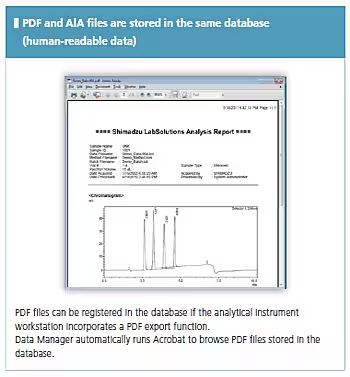
LabSolutions complies with the requirements of the FDA 21 CFR Part 11 (Electronic Records, Electronic Signatures). LabSolutions provides secure data management and electronic signature operations for measurement results registered in a database acquired from a range of instruments, including HPLC, GC, GC-MS, LC-MS, UV, FTIR, and balances, as well as other manufacturers’ products. The data is automatically saved in the database for subsequent easy searching. Additionally, the associated method and schedule information, date of measurement, operator’s name, and analytical report image files (in PDF format) are stored together. Client/server capability allows centralized management of data from all instruments and simple data referencing from a client PC.
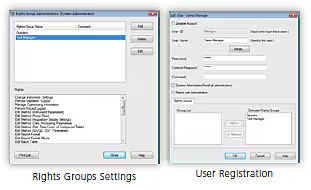
LabSolutions’ user administration comprises the setting of rights groups and assignment of rights to users just as in Windows. It enables the easy setting of user access rights as well as rights groups matched to each user’s required tasks. Functions such as these achieve effective user administration matched to laboratory operations from managerial tasks to data acquisition operations.
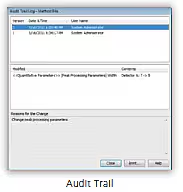
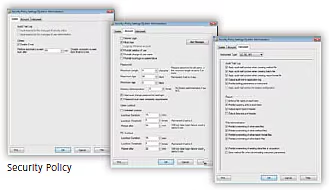
Features functions for setting an audit trail to ensure data reliability and formailing events occurring on the system. It includes various settings, such as setting the length, expiration date and complexity of passwords for user accounts, setting the lockout function to prevent illegal access, and registering settings for the deletion and alteration of registered users, to enable highly secure system operation. Settings for overwriting data files and other information and relating to items to output in reports also are supported.
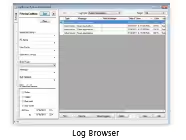
The Log Browser allows the user to easily ascertain system status from operation and administration to usage status and error status. Functions to search for log details, user names, instrument names, etc. also are provided in order to verify the necessary information.
The change history of method files is managed by the audit trail. Application of the audit trail to all methods can also be set in the security policy settings. This prevents inconsistencies in compliance with regulations. A history of postrun analysis after data acquisition can also be managed by applying the audit trail to data files.