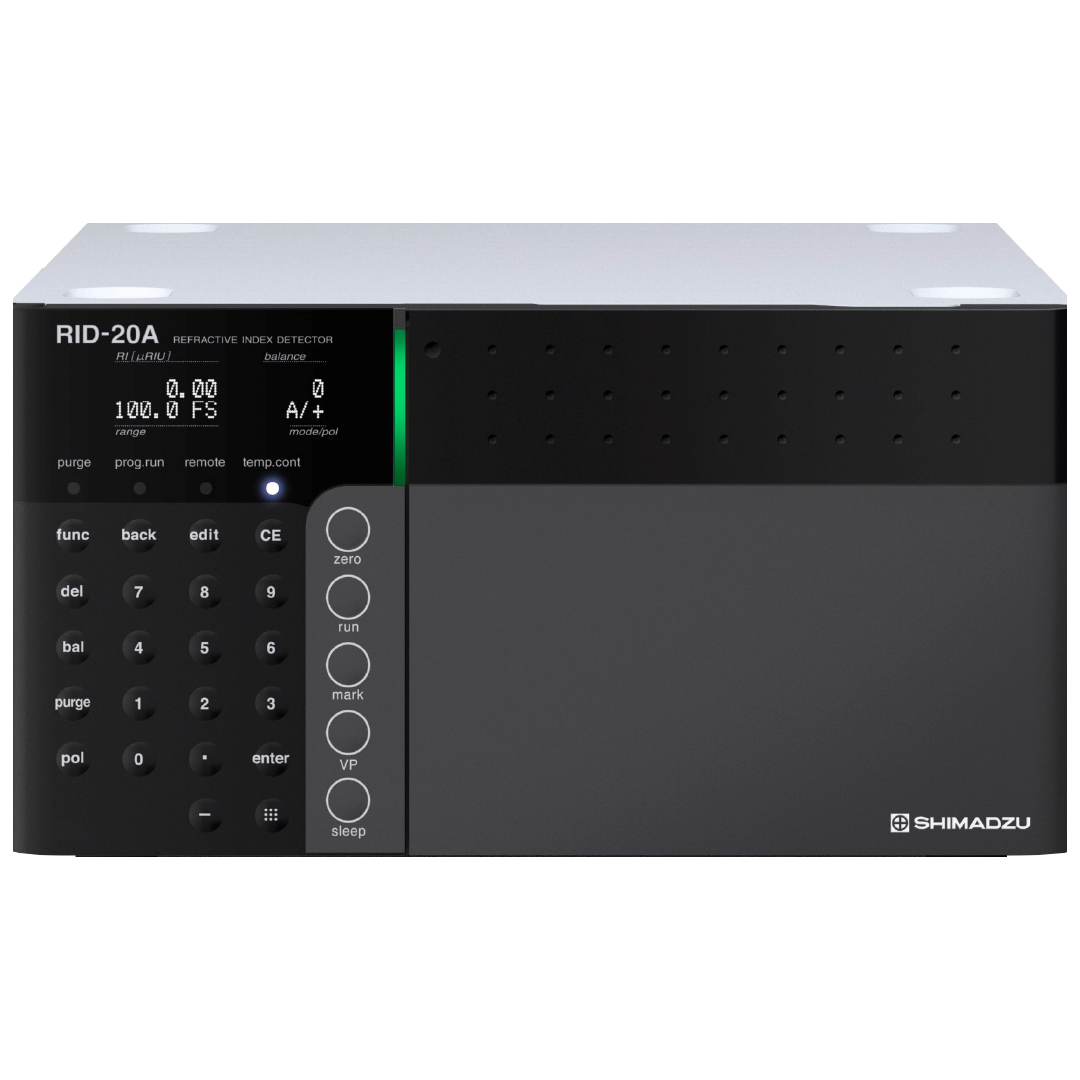
Inheriting the stability and extensibility that are the strengths of the Prominence series, the new RID-20A model of differential refractive index detector is designed with a new reference-cell auto-purge feature and validation support function.
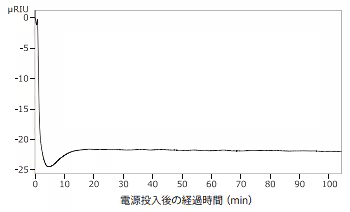
Reduced Stabilization Time and Improved Baseline Stability :After 30 Minutes Power on
The RID-20A reduces the time to stabilization after power-on dramatically by utilizing dual temperature control for the optical system. The stable baseline provides the accurate analysis of the molecular weight distribution.
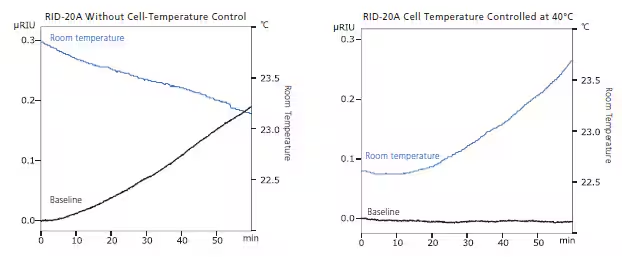
Short Warm-up Time and Improved Baseline Stability
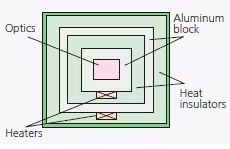
The optical system is housed inside a dual-temperature-controlled block. The temperature of the incoming mobile phase is controlled in two stages; consequently, the stabilization time is significantly shorter than with conventional systems. This dual-temperature control also helps significantly reduce baseline drift, thus increasing the reliability of analysis data.
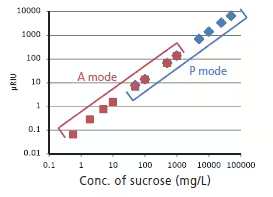
The four-partition photodetector in the RID-20A allows a wide refractive index range (0.01 to 5000 μRIU). The single detector supports all applications from highly sensitive measurements to preparative measurements using the three operation modes shown below.
A (Analytical) Mode
High-sensitivity to general-purpose analysis
P (Preparative) Mode
High-concentration analysis, semi-preparative analysis (up to 20 mL/min)
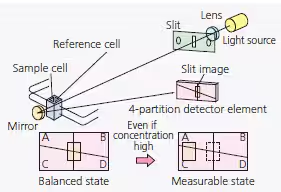
The detector element of the RID-20A is partitioned into four parts, and the parts used can be changed electrically. In A mode (for high-sensitivity analysis), the partitions are grouped left-right (combinations of A+C and B+D), and in P and L modes (for preparative analysis), the partitions are grouped top-bottom (combinations of A+B and C+D). In P and L modes, because measurement is possible regardless of the position of the element’s center line, large refractive indexes for high-concentration samples can be handled.